
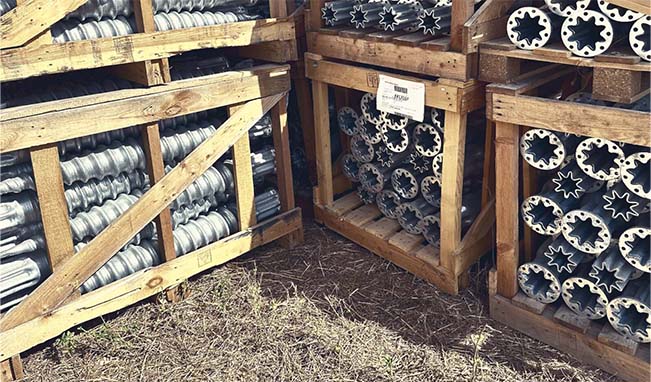
Ground screws and concrete foundations can both provide effective structural support, but they solve project conditions in very different ways. Ground screws can reduce excavation, eliminate concrete curing time, and simplify foundation work on projects where schedule, access, or site disturbance are important. Concrete foundations, however, remain a practical and sometimes preferable choice depending on structural loads, soil conditions, permanence, and project requirements.
The right foundation approach should therefore be based on the specific project rather than on a universal preference for one system. This guide compares ground screws vs concrete foundations across the factors that typically matter most to contractors, developers, engineers, and project owners.
Ground Screws vs Concrete Foundations: Comparison
Factor |
Ground Screws |
Concrete Foundations |
| Installation Speed | Can often be installed quickly and do not require concrete curing time. | Require excavation, placement, and curing before subsequent construction can proceed. |
| Excavation and Site Disturbance | Typically require less excavation and generate less spoil. | Usually require more excavation, forming, and site preparation. |
| Weather Sensitivity | Installation can be less dependent on curing conditions, although site and equipment limitations still apply. | Placement and curing can be affected by temperature, precipitation, and site conditions. |
| Soil and Site Conditions | Can work well in many soil profiles, but dense soils, rock, obstructions, or unsuitable subsurface conditions may limit use. | Can accommodate a wide range of applications but may require additional excavation, reinforcement, or ground preparation. |
| Structural Capacity | Capacity depends on soil conditions, shaft and helix configuration, embedment, and project-specific engineering. | Can be designed for a broad range of structural loads and geometries. |
| Site Access | Installation equipment can be compact for some systems, making screw foundations useful on constrained sites. | Excavation, concrete delivery, forming, and reinforcement can require greater working space and site access. |
| Removal and Reuse | Some systems can be removed, and certain components may be reusable depending on their condition and the application. | Generally intended as permanent foundations and typically require demolition for removal. |
| Environmental Impact | Can reduce concrete use, excavation, and soil disturbance for suitable projects. | Uses more concrete and normally creates a larger excavation footprint, although actual impacts depend on the project. |
| Best Fit | Often attractive for modular, solar, temporary, constrained-access, and schedule-sensitive projects. | Often appropriate for conventional buildings, complex geometries, heavy structural demands, or conditions favoring cast-in-place foundations. |
Speed and Construction Schedule
One of the clearest differences between ground screws and concrete foundations is the effect each system can have on the construction schedule.
Ground screws can often be installed without excavation-intensive footing work and do not require concrete curing time. Once the selected system has been installed and accepted for the project, subsequent construction activities may be able to proceed sooner.
Concrete foundations typically require excavation, forming, reinforcement, concrete placement, and a curing period before they can support the next stages of construction. Weather conditions can also influence placement and curing schedules.
For modular buildings, solar installations, temporary structures, and other schedule-sensitive projects, this difference can make ground screws particularly attractive. However, the actual time advantage depends on site conditions, system size, installation equipment, access, testing requirements, and the overall project sequence.
Excavation, Site Disturbance and Weather
Ground screws typically require less excavation than conventional concrete foundations because the foundation elements are installed directly into the ground rather than placed in excavated footings. This can reduce spoil removal, disturbance to surrounding surfaces, and the amount of restoration required after foundation work is complete.
Concrete foundations generally require excavation, forming, reinforcement, concrete placement, and access for material delivery. On constrained or already developed sites, these activities can require more working space and coordination with other trades.
Ground screws also eliminate concrete curing from the construction sequence. This can reduce sensitivity to some weather-related delays, although installation is still affected by site access, soil conditions, groundwater, frozen ground, and the equipment required for the selected system.
For projects where minimizing disruption is important, ground screws can therefore offer a practical advantage. The actual benefit depends on the site and should be evaluated alongside structural requirements, soil conditions, and long-term foundation needs.
Structural and Site Limitations
Ground screws are not suitable for every site or structural condition. Dense rock, large subsurface obstructions, highly variable soils, limited installation access, or unusually high structural demands can require a different foundation approach or additional engineering.
Concrete foundations offer greater flexibility for certain structural geometries and can be designed for a very broad range of loading conditions. In some projects, particularly where excavation is already required or where foundation geometry is complex, concrete may remain the more practical solution.
The decision should be based on geotechnical information, structural loads, access, connection requirements, and the intended service life of the structure.
Cost Drivers
Neither ground screws nor concrete foundations are automatically the lower-cost option.
Ground screws can reduce excavation, spoil removal, concrete placement, curing time, and some site-restoration work. These advantages may produce meaningful savings on projects where construction speed or restricted access would otherwise add cost.
Concrete foundations may be more economical where materials, labor, and excavation equipment are readily available or where the project already requires substantial concrete work.
A realistic comparison should consider the entire installed foundation package, including engineering, materials, equipment, labor, site preparation, testing, logistics, schedule impact, and restoration.
Durability and Corrosion Considerations
Both foundation types can provide long service life when they are properly designed for the project environment.
For ground screws and helical piles, durability depends in part on steel specification, corrosion protection, soil chemistry, groundwater exposure, design life, and the amount of material available for long-term corrosion allowance.
Concrete durability depends on factors such as concrete mix, reinforcement protection, drainage, environmental exposure, freeze-thaw conditions, and construction quality.
Neither system should be considered inherently maintenance-free or universally more durable. The service environment and project-specific design requirements determine the appropriate protection strategy.
Removal, Reuse and End of Life
One potential advantage of screw foundations is that certain systems can be removed after use rather than demolished in place. This can be particularly useful for temporary buildings, relocatable structures, solar installations, and sites where future restoration is important.
Some removed components may also be suitable for reuse, depending on their condition, original design, corrosion exposure, and the requirements of the next application. Reuse should therefore be evaluated rather than assumed.
Concrete foundations are generally intended to remain permanently in place. Removal typically involves demolition, excavation, material handling, and site restoration.
Where Each Foundation Approach Fits Best
Ground Screws Are Strong Candidates When |
Concrete or Another Foundation May Be Preferable When |
|
|
The appropriate foundation system depends on structural loads, soil conditions, installation access, project geometry, permanence, and project-specific engineering requirements. The goal is not to identify a universal winner, but to select the system that best fits the actual project conditions.
Decision Checklist
-
What compression, uplift, and lateral loads must the foundation support?
-
What is known about the soil profile and groundwater conditions?
-
How much excavation and site disturbance is acceptable?
-
How important is foundation installation speed to the schedule?
-
What access is available for installation equipment and material delivery?
-
Is the structure permanent, temporary, or potentially relocatable?
-
What service life and corrosion environment must be considered?
-
What documentation, testing, and engineering review will be required?
For projects where ground screws or helical piles appear to be a strong fit, the next step is to evaluate the available systems against the specific structural and site requirements.
Explore A Priori Source Ground Screw Foundation Systems and Helical Piles.